Like souls that balance joy and pain, With tears and smiles from heaven again The maiden Spring upon the plain Came in a sun-lit fall of rain. In crystal vapour everywhere Blue isles of heaven laugh'd between, And far, in forest-deeps unseen, The topmost elm-tree gather'd green From draughts of balmy air. Sometimes the linnet piped his song: Sometimes the throstle whistled strong: Sometimes the sparhawk, wheel'd along, Hush'd all the groves from fear of wrong: By grassy capes with fuller sound In curves the yellowing river ran, And drooping chestnut-buds began To spread into the perfect fan, Above the teeming ground. Then, in the boyhood of the year, Sir Launcelot and Queen Guinevere Rode thro' the coverts of the deer, With blissful treble ringing clear. She seem'd a part of joyous Spring: A gown of grass-green silk she wore, Buckled with golden clasps before; A light-green tuft of plumes she bore Closed in a golden ring. Now on some twisted ivy-net, Now by some tinkling rivulet, In mosses mixt with violet Her cream-white mule his pastern set: And fleeter now she skimm'd the plains Than she whose elfin prancer springs By night to eery warblings, When all the glimmering moorland rings With jingling bridle-reins. As she fled fast thro' sun and shade, The happy winds upon her play'd, Blowing the ringlet from the braid: She look'd so lovely, as she sway'd The rein with dainty finger-tips, A man had given all other bliss, And all his worldly worth for this, To waste his whole heart in one kiss Upon her perfect lips. ![]() |
Wednesday, July 29, 2009
Winsome Words for Wednesday
Tuesday, July 21, 2009
Sing a Song of Serpents

Everyone has heard the tale about the snake that tricked Eve. We all know about dangerous dragons, petrifying basilisks, and vengeful sea serpents.
What about the protector; a snake king shielded Buddha during his meditations. The Gadsden flag of the American Revolution is a rattler warning “Don’t Tread On Me.” The wisdom of Pythia, the Oracle at Delphi. The knowledge of Sophia.
Minoan priestesses clutched snakes, so did Moses. There’s Kundalini and the caduceus. The crown of Egypt. Medusa’s crown of hissing locks. So many world mythologies have serpents coiled about the World Tree, the Tree of Life.
Snakes have venom that can poison, heal, or take you on a magical mystery trip. They tell us about renewal as they shed their skin, about eternity when they eat their tail.
Fire, water, air and earth; rainbows, feathers; Chthonic birth-death-rebirth, earth and the underworld. It’s all there. I told you snakes have big mojo.
Now, for the sparkly snakey shinies. Victorians were so cool in their love for weird and creepy jewelry.
A bangle bracelet circa 1845; hundreds of pave set natural turquoise cabochons, rose cut diamonds and ruby cabochon stones.

Sarah Bernhardt's Cleopatra handflower, made designed by Alphonse Mucha and created by Georges Fouquet in 1899; gold, enamel, opal, diamond. Mermaiden Creations snake skin pendants; shed skin preserved under glass with spiral accents reinforcing symbolism.


Friday, July 10, 2009
It's My Birthday and I'll Blog If I Want To
Thursday, July 2, 2009
Touching Ancient Byzantium
I think every once in a while, I will share my latest favorite finds from Ancient Touch http://www.ancienttouch.com/index.htm
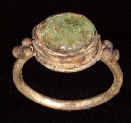
Today I found these beautiful jewelry artefacts from ancient Byzantium. The ring is silver set with a green glass piece, made in VII c A.D. The earring is gold, from the second half of VII-IX c. A.D., and it looks just like a pomegranate to me.
Byzantium was founded by Greeks in 667 BC and was dedicated to Artemis, bearing the crescent moon as its symbol for nearly a thousand years until conquered by Rome in 196 AD. Being a crossroads harbor between the Black Sea and the Mediterranean Sea, its strategic location drew the eye of Emperor Constantine, who rebuilt the city and renamed it Nova Roma. Upon his death it became Constantinople and remained a Greek-speaking Roman state. The Middle Ages brought about the final change of rule with the Ottoman Empire’s crusader conquest and the eventual name of Istanbul in modern times. Historians use the term Byzantine for cultural and land references. Over the centuries the Byzantine Empire survived the collapse of the Western Roman Empire underwent ebbs and flows of power and status, but became known as a wealthy independent center of Christianity, culture, education and artistry. Even in the downturns, citizens continued to adorn themselves; they just used less expensive materials.
Over the ages, the jewelry of Byzantium became crowded with influences (Greco-Roman, Italian, French, German, Middle Eastern) due to the prominent trade industry and the wealth of the city, though the most recognizable and abundant pieces are heavily jeweled crosses. Women of all classes wore earrings, and rings were widely worn as well (following Roman tradition). Other items include crowns for the nobility, necklaces, brooches, fibula and belts. When the Ottomans gained control of the city, the amount of jewels and opulence increased according to the sultan’s preferences and show of power. Tribal motifs were introduced, and the Ottoman women preferred to wear headdresses and ornamentation, and more bracelets were worn as well.
I mentioned Byzantium’s location at the mouth of the Black Sea. There is something special about the deep, cold waters, in that they are deprived of oxygen so that wood-boring mollusks cannot live, and therefore cannot destroy shipwrecks and their cargo (including human remains) as in other maritime areas trafficked in the ancient world. Wooden shipwrecks of antiquity are remarkably well preserved for thousands of years and are a unique source of study for marine archaeologists.


Fascinated by these discoveries and the treasures and secrets they have to reveal, I dreamed up some earrings that I imagine might be uncovered in one of these ancient shipwrecks one day…Byzantium’s Harbor Earrings in sterling, and Byzantium and the Black sea in brass.
Wednesday, July 1, 2009
Wistful Words for a Wednesday

Monday, June 8, 2009
2,500 Year Old Tweet Discovered
Women of the day were not educated and not very well respected. There were basically three classes a woman fit into: a slave who was, well, a slave; a citizen, to be married off by her father and ruled by her husband; a Hetaerae, who was an educated prostitute. If women were so controlled and stifled, why then are there so many bad ass Greek Goddesses? It seems that there are earlier writings, though not so many surviving, which indicate women were held in esteem in society and ritual. As patriarchal education emerged, respect for women and their rights sadly decreased. One important role women maintained was that of religious and ritual significance. I guess the old patriarchal farts were too cautious to risk seeing what would happen if the temples to Artemis were torn down and replaced by penis monuments. Ok, so maybe Aphrodite was down with that, much to Sappho’s irritation, but Athena was having none of it.
While the hetaerae were free to roam about, amusing themselves with shopping, the theatre, strumming a lyre or other objects, the world was small for the average Athenian woman. She was forced to remain inside the home always, save for a ritual or two. If she were to use Twitter and Tweet out her day, here’s something we might see from *AthensIsForAtholes*:
7:05 Rise
7:08 Eat small piece of bread soaked in wine. Still hungry, but must be careful about figure.
7:09 Peck husband on cheek, send him off to the agora. Sigh. Look at 4 bare (slightly tinted) walls. Rarely allowed out of house, prepare for another day at home.
7:15 Summon hand maiden for cooling with huge peacock feather.
8:30 All dressed up with no place to go, wander into kitchen, see a piece of honey cake. Resist.
9:27 Hear argument between two servants, rush out to mediate.
11:15 Wander into courtyard near flowerbed where slave girls are spinning and giggling. Ask to join them. Reminded this is improper behavior - they suggest I get ready 4 lunch.
12:15 Husband arrives, chiding about the foolishness of make-up. Pretend to agree. Husband leaves at 12:22
3:00 Instruct daughter on her duties of being a wife.
8:05 With husband sit down at low table to dinner; bread, oil, wine, a few figs, small portion of fish (only 320 calories) and beans. Hear about his day. Tells me shouldn't bother about the affairs of men. Pretend to agree. Too hungry to argue.
10:10 Fall asleep. I do not dream of tomorrow.
(I adapted this into tweet format, excusing the occasional liberties of more than 140 words, from Lynn Schnurnberger's book Let There be Clothes: 40,000 Years of Fashion)
I’ve come across some items from the time period in discussion here, but one must wonder which woman they belonged to. The housewife or the hussy? Regardless, these are some gorgeous bits of a woman’s toilette, a hand mirror, an arm band, and a cosmetic jar; picture them on a dressing table 2,500 years ago.
Wednesday, June 3, 2009
Wonderful Words for Wednesday
the rain,
(Who feathers frightened fields
with the superior dust-of-sleep. wields
easily the pale club of the wind
and swirled justly souls of flower strike
the air in utterable coolness
deeds of green thrilling light
with thinned
newfragile yellows
lurch and.press
-in the woods
which
stutter
and
sing
And the coolness of your smile is
stirringofbirds between my arms;but
i should rather than anything
have(almost when hugeness will shut
quietly)almost,
your kiss